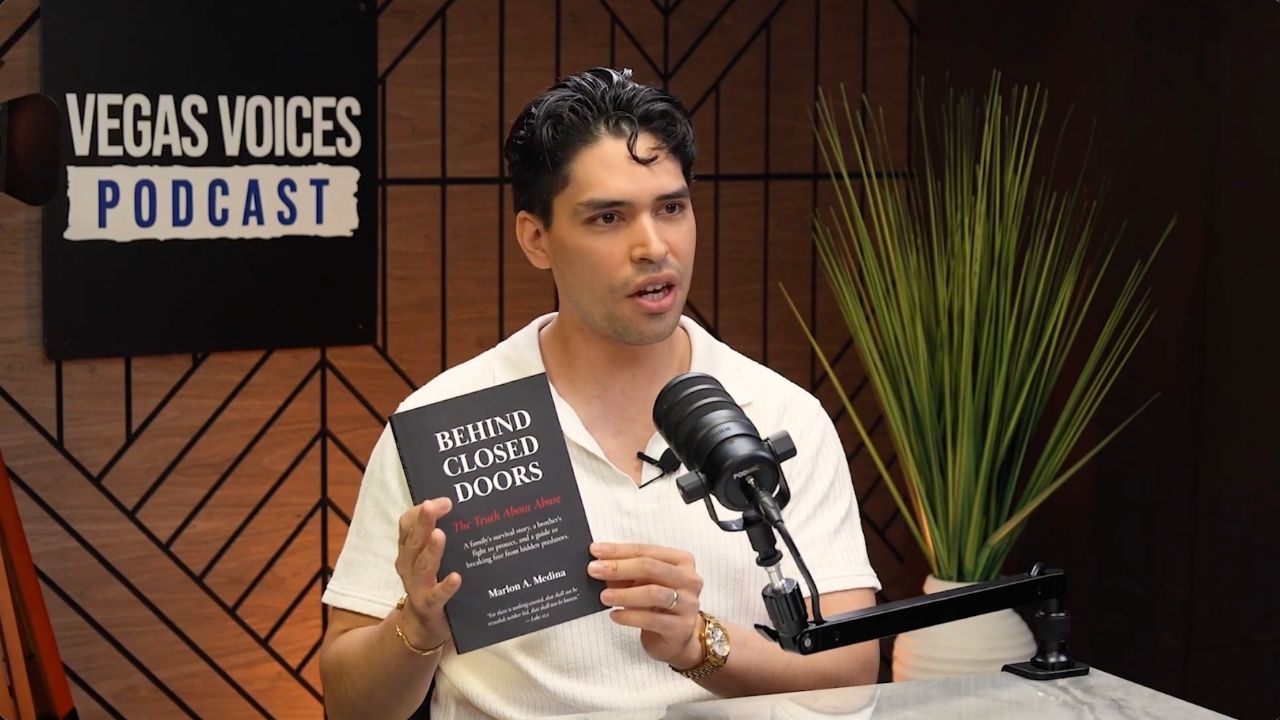
Who Is Marlon A. Medina? Reflections on Business, Storytelling, Faith, and Purpose
Over the years, I've worn a number of different hats.
Some people know me as the founder of Golden Medina Services, where I help businesses and organizations tell their stories through strategic branding, photography, video production, and digital marketing. Others have come across my work through civic engagement, community forums, or advocacy surrounding child abuse prevention. More recently, some have discovered me through my book, Behind Closed Doors, which explores the long-term effects of abuse and the importance of awareness, prevention, and institutional accountability.
At first glance, those interests can seem unrelated. Marketing. Research. Advocacy. Politics. Faith. Community organizing.
But to me, they've always been connected by one central idea:
Stories shape people, and people shape the world.
Recently, I had the opportunity to sit down with Sergio Chavez on the Vegas Voices Podcast for one of the most personal conversations I've shared publicly. We talked about entrepreneurship, personal branding, artificial intelligence, faith, leadership, and the experiences that have shaped my work over the last decade.
Like most podcast conversations, there were only so many directions we could go within the time we had. Looking back, I realized there were several ideas that deserved a little more reflection than an interview format allows.
This article is my opportunity to expand on those conversations.
If you're discovering my work for the first time, I hope this gives you a better understanding of the person behind the projects. And if you've followed my journey for years, I hope it provides a little more context for where I'm headed next.
Building a Business Was Never the End Goal
If someone asked me ten years ago what I wanted to become, "marketing agency owner" probably wouldn't have made the list.
I didn't grow up dreaming about producing commercials or running advertising campaigns. I grew up wanting to create.
As a kid in Las Vegas, I was fascinated by nature. I spent hours watching Steve Irwin, sketching animals, and getting lost in books about wildlife. I was originally an illustration major because drawing felt like the most natural expression of how I saw the world. Creativity was how I understood life.
Like many college students, though, passion eventually collided with reality and I needed work.
During my time at UNLV, I attended an internship fair where a company in need of marketing approached me and encouraged me to apply. At the time, I knew very little about digital marketing, but I threw myself into learning everything I could. Search engine optimization. Social media strategy. Brand positioning. I absorbed every lesson I could find.
Looking back, I don't think marketing replaced my passion for creativity, but it certainly gave creativity a practical purpose.
Instead of creating artwork for its own sake, I began helping businesses communicate who they were. I realized that every company, every entrepreneur, and every community leader already had a story. My job wasn't to invent one, it was to uncover it and present it in a way that people could genuinely connect with.
That realization eventually became the foundation for Golden Medina Services.
Over the years, our work has expanded well beyond producing content. We've worked with entrepreneurs launching their first businesses, nonprofits raising awareness for important causes, attorneys helping families through difficult seasons, and community organizations trying to make a lasting impact.
The real work has always been helping people communicate something meaningful.
The Person Who Believed in Me Before There Was Proof
When people ask how Golden Medina Services came to exist, they often expect me to talk about cameras, clients, or business strategy. Instead, I usually begin with my wife.
Long before there was a company, there was simply a college student with a lot of ambition and very little certainty. I had ideas. I had creativity. I had a willingness to work hard. But like many young entrepreneurs, I also had moments where I questioned whether any of it would amount to something. The difference was that I wasn't carrying those dreams alone.
Shortly after we became engaged, I remember asking her what she thought about starting a digital marketing business. At the time, social media was changing rapidly, creators were beginning to build businesses online, and I felt there was an opportunity to help people tell their stories in a more authentic way. It was certainly a risk. Neither of us knew exactly what the future would look like.
She believed in it anyway.
Looking back, that belief was worth more than any investment or business loan could have been.
Entrepreneurship is often romanticized as the story of one determined individual overcoming impossible odds. We celebrate founders, CEOs, and visionaries, but we rarely acknowledge the people who quietly carry those visionaries through seasons of uncertainty.
There were months when clients were slow to respond. There were proposals that never turned into contracts. There were moments when I genuinely wondered whether I should walk away from everything we had built.
More than once, I told her, "Maybe it's time to quit." More than once, she reminded me how far we had already come.
That perspective became one of the greatest gifts anyone has ever given me.
It's easy to measure success by looking at what's still missing. It's much harder, and much healthier, to stop and recognize how much progress has already been made.
Businesses can grow. Revenue can fluctuate. Industries will continue to change. But the people who believe in you before success is guaranteed? Those are the people who shape your life in ways no balance sheet can ever measure.
If this journey has taught me anything, it's that none of us truly build alone. Behind every entrepreneur whose name appears on the website is usually someone whose name never does.
Why I No Longer Believe Success Is a Solo Game
One of the biggest misconceptions I had as a young entrepreneur was believing that success belonged to whoever could do everything themselves.
I wanted to build my own business. I wanted my own clients. My own reputation. My own version of success.
In many ways, I treated entrepreneurship like a competition rather than a community. I wasn't hostile toward other people, I simply believed that the less I depended on others, the stronger I would become. Time proved me wrong.
As Golden Medina Services grew, I started meeting incredibly talented people who possessed skills I didn't. Photographers, developers, researchers, political leaders, attorneys, and business owners all brought different perspectives that made projects stronger than anything one individual could have produced alone.
Eventually, I realized something that now seems obvious.
No great institution, movement, or company has ever been built by one person. History simply doesn't work that way.
During the podcast, I mentioned an episode of Little House on the Prairie that unexpectedly stuck with me. A family settles on a piece of land with nothing around them. No contractors, no equipment, no infrastructure. The only way they can build a home is by asking another family for help, with the promise that one day they will return the favor.
That image has stayed with me. It's a reminder that communities have always been built through mutual trust long before they were built through transactions. Somewhere along the way, I think we've forgotten that.
Modern business often teaches us to view every interaction through the lens of competition. We ask, "What can I gain?" before asking, "How can I help?" Networking has become increasingly transactional. Relationships are often measured by immediate return rather than long-term trust.
Ironically, the greatest opportunities in my own career have rarely come from chasing them. They've come from relationships. From helping someone solve a problem without expecting anything in return. From introducing two people who could benefit from knowing each other. From staying in touch with someone for years before a single project ever materialized.
Collaboration isn't a shortcut to success, it's the very foundation. That realization has changed the way I lead my company. When clients work with us, I don't want them to feel like they're hiring another vendor. I want them to feel like they're gaining a long-term partner.
Leadership isn't about being the smartest person in the room. It's about creating an environment where other people can contribute their strengths without feeling like they have to compete for significance.
I'm grateful that the younger version of myself wanted to build an empire. At the time, he just didn't realize that every lasting "empire" is really a community built on relationships.
Marketing Isn't About Selling. It's About Helping People Be Seen.
One of the questions I get asked most often is what do I do exactly. The easy answer is that I run a marketing agency. The more honest answer is that I help people tell stories they often don't realize are worth telling.
Over the years, I've met countless business owners who have said some version of the same thing:
"There's nothing interesting about me."
During the podcast, I shared a conversation with a client who compared herself to others we had worked with. She looked at their success and immediately assumed they were naturally more interesting, more accomplished, or somehow more deserving of attention than she was.
She couldn't see what everyone else could. She couldn't see her own value.
Sometimes people don't need someone to invent a better story. They simply need someone to help them recognize the one they've already lived. That's where I believe authentic branding begins.
It’s not about a logo or a perfectly curated Instagram feed. It begins with honesty. People don't connect with perfection. They connect with humanity.
They remember the business owner who struggled through difficult seasons before finding success. They remember the physician who chose medicine because of a personal experience. They remember the attorney whose passion was shaped by watching injustice firsthand. They remember the nonprofit founder who couldn't ignore a problem any longer.
Facts inform. Stories endure.
That's why I often describe marketing as introducing one person to another.
Before the internet, relationships were built through conversations, introductions, and communities. Someone would say, "You need to meet this person," because they believed the connection would benefit both people. Digital marketing, at its best, is simply that same introduction taking place online.
Businesses often feel pressure to appear flawless. Every post becomes another opportunity to demonstrate expertise, revenue, growth, or prestige. Before long, the business begins sounding less like a person and more like a brochure.
The problem is that audiences are remarkably good at detecting the difference. People don't build trust with brands because they appear perfect. They build trust because they appear real. That doesn't mean every detail of your personal life belongs on the internet. Authenticity isn't oversharing. It's alignment. It's making sure the person someone meets online is fundamentally the same person they would meet across a coffee table.
In the long run, authentic stories outlast marketing trends, and authentic people outlast carefully manufactured brands.
Authenticity in the Age of Artificial Intelligence
Artificial intelligence has become one of the defining conversations of our time. As someone who works in digital marketing every day, people often assume I'm either completely enthusiastic about AI or completely opposed to it. The truth is somewhere in the middle.
I use AI. Our company uses AI.
It is one of the most transformative technologies we'll see in our lifetime. The real question is this:
What should humans never give away?
Technology has always changed the way we work. The internet changed communication. Smartphones changed accessibility. Social media changed distribution. AI is changing production.
None of those innovations are inherently harmful. The danger comes when efficiency begins replacing humanity instead of supporting it.
I have no problem using AI to organize research, summarize documents, generate outlines, or help structure information. Those are tasks that often consume valuable time without adding much human value. If technology can eliminate unnecessary friction and allow people to focus on higher-level thinking, that's a win.
Where I become more cautious is when businesses try to outsource the very thing that makes them trustworthy.
Relationships. Empathy. Judgment. Presence.
I've seen companies generate AI avatars to speak on their behalf. I've seen nonprofit campaigns built around artificial imagery instead of real people. I've watched organizations try to replace genuine conversations with automation because it feels faster or more scalable.
Here the issue: trust doesn't scale the same way technology does.
If I'm hiring an attorney, I want to hear from the attorney who may one day stand beside me in court.
If I'm trusting a physician with my health, I want to hear from the physician, not a digital avatar.
If I'm considering donating to a nonprofit, I want to know the people behind the mission.
Those moments require human presence because they involve human trust.
Ironically, I believe AI is making authentic people more valuable, not less.
As synthetic content becomes easier to produce, genuine human experience becomes increasingly difficult to imitate. Anyone can generate beautiful graphics or polished copy within seconds. Far fewer people can communicate wisdom earned through failure, compassion shaped by hardship, or conviction developed over years of experience.
Those things cannot simply be prompted into existence. They need to be lived.
The businesses that will thrive over the next decade won't necessarily be the ones using the most advanced technology. They'll be the ones using technology without losing their humanity.
At Golden Medina Services, that's the balance we're continually striving for.
Technology should never replace the relationships we're trying to build.
Marketing has always been about people. No matter how sophisticated our tools become, I don't believe that fundamental truth will ever change.
When the Work Became Personal
There are moments in life that quietly redirect everything. You won't immediately understand how deeply they'll change the way you think, the people you trust, or the responsibilities you'll eventually feel called to carry.
For me, one of those moments came when I learned of abuse that occurred within my own family across multiple generations.
Once all the pieces began coming together and I came to a full realization of what happened, I couldn't simply move on.
I still had clients to serve. A business to run. Responsibilities to fulfill. Life doesn't pause simply because you uncover atrocities. But internally, everything had shifted. I found it difficult to think about anything else.
The more I researched childhood abuse, trauma, institutional failures, and long-term recovery, the more I realized how much I didn't know, and how much most people don't know. The realization was both heartbreaking and motivating.
I didn't write Behind Closed Doors because I wanted to become an author. I wrote it because I needed to make sense of what I had learned.
Writing became part research, part reflection, and part healing. It gave structure to questions that had lived in my mind for years. It forced me to slow down, evaluate evidence carefully, and wrestle with uncomfortable realities that cannot be reduced to headlines or social media posts.
What surprised me most throughout that process wasn't simply the prevalence of abuse. It was how invisible it often remains.
“You could see someone walking down the street, and you would never know they were a victim of multi-year abuse.”
That thought has never really left me.
We often imagine survivors fitting a certain image or carrying obvious signs of trauma. But reality is rarely that simple.
Many survivors become professionals.
Parents. Teachers. Business owners. Neighbors. Friends.
Some carry extraordinary resilience. Others carry wounds that no one around them can see.
That realization fundamentally changed the way I interact with people.
It made me slower to judge and more willing to listen. More aware that every person I meet is carrying experiences I may never fully understand.
In many ways, it also changed how I approach my work.
Whether I'm helping someone build a personal brand, documenting a nonprofit's mission, or speaking at a community event, I try to remember that the person sitting across from me is more than their profession.
They're someone's child. Someone who's experienced victories, disappointments, fears, and hopes that I'll probably never know completely.
That perspective has made me a better marketer. But more importantly, I hope it has made me a better human being.
I believe difficult experiences carry a responsibility.
If we've learned something that can protect someone else. If we've gained knowledge that can help another family recognize warning signs. Then we have an obligation to share them.
That's ultimately why I continue this work.
Not because it's easy. Not because it's profitable. But because awareness has the power to prevent silence.
If my work (in business, writing, research, or advocacy) can help even one person recognize a danger they might have otherwise missed, then every difficult conversation has been worth having.
Awareness Is Only the Beginning
Awareness without action eventually becomes just another headline. Another social media campaign. Another conversation that fades as soon as the news cycle moves on.
If we genuinely want to protect children, awareness has to lead somewhere. It has to change how our institutions respond.
When I use the word institutions, I'm talking about the places that shape everyday life.
Families.
Churches.
Schools.
Community organizations.
Law enforcement.
Government.
None of these institutions are perfect.
Every one of them is made up of imperfect people.
But each one has a responsibility to create environments where abuse is less likely to occur, where warning signs are recognized early, and where victims are believed rather than dismissed.
Too often, we only begin asking difficult questions after tragedy has already occurred. I'd rather we become comfortable asking those questions before lives are permanently altered.
I believe most people genuinely want to protect children. The challenge is that many don't know what they're looking for. They don't recognize behavioral changes. They don't understand grooming tactics.
They assume abuse always looks obvious, when unfortunately, it often doesn't. That's one of the reasons I wrote Behind Closed Doors.
I don’t think any one book can solve a problem this large. But I do believe education gives ordinary people the confidence to recognize situations that previously felt impossible to identify.
Over the past few years, I've also become increasingly involved in civic conversations throughout Las Vegas and beyond. I've had the privilege of helping organize discussions that brought together people from very different political perspectives. While the participants rarely agree on much, there is one area where shared conviction is found: protecting children.
That gives me hope. It reminds us that not every issue is partisan. Some causes are simply human.
Whether someone approaches the issue through faith, public health, education, law enforcement, or public policy, the destination is ultimately the same.
Children deserve to grow up in environments that are safe. Survivors deserve to be heard. And institutions deserve to be held accountable.
But accountability must be consistent. It's easy to demand transparency from institutions we disagree with. It's much harder to demand it from institutions we love. Real integrity requires both.
Whether it's a church, a school, or a government agency, protecting reputations can never become more important than protecting people.
That principle shouldn't change depending on who is involved. If anything, our highest standards should be reserved for the institutions we trust the most.
Meaningful change happens because ordinary people decide they're no longer willing to look away.
They learn to ask better questions. They educate themselves. And they continue showing up long after public attention has moved on.
If there's one thing I hope readers take away from my work, it's this:
Awareness is not the finish line. It's the invitation to begin.
Living With Purpose Without Losing Wonder
One lesson I've had to learn over the years is that carrying a meaningful mission doesn't require carrying the weight of the world every moment of every day. In fact, I think the opposite is true.
If we're going to do difficult work over the long term, we have to remain connected to the things that remind us why the work matters in the first place.
Every client I meet, every conversation I have, every community project I become involved in begins with the same curiosity:
"What shaped this person?"
I've found that when you approach people with genuine curiosity instead of assumptions, you learn far more than you ever expected. That mindset has influenced both my personal life and my business.
Every photograph, every interview, every campaign, and every conversation captures a life that can never be repeated. Perhaps that's why storytelling continues to fascinate me after all these years.
What I Hope My Life Stands For
"When someone says your name ten years from now, what do you hope comes to mind?"
I hope people would say, "He was one of the good ones."
I don’t want to be remembered just by my company or my audience. But because I tried to leave people better than I found them.
I've come to realize that success has seasons. Businesses grow. Industries evolve. Technology changes. Even the work we're most proud of eventually becomes part of history.
Character is one of the few things that continues to compound over a lifetime.
When I look back over the past decade, I don't just see the milestones. I see the people.
The mentor who took a chance on a college student with no experience.
The clients who trusted a young entrepreneur before he had an impressive portfolio.
The conversations that changed my thinking.
The opportunities that arrived long before I felt ready for them.
The truth is, none of us become who we are in isolation.
Every meaningful accomplishment carries fingerprints that aren't our own.
That's one of the reasons gratitude has become increasingly important to me. It's easy to look ahead and focus on what's next. But gratitude reminds us that every opportunity carries a responsibility.
Truth matters. People deserve justice. Integrity is worth protecting, even when no one is watching.
If my life communicates those values more clearly than my words ever could, I'll consider it time well spent.
For those who have followed my journey over the years, thank you.
For those discovering my work for the first time, welcome.
Whether our paths cross through marketing, research, advocacy, civic engagement, or simply a shared conversation over lunch, I hope one thing remains consistent:
That you leave knowing there is still tremendous value in honest work, thoughtful dialogue, genuine relationships, and stories told with integrity.


