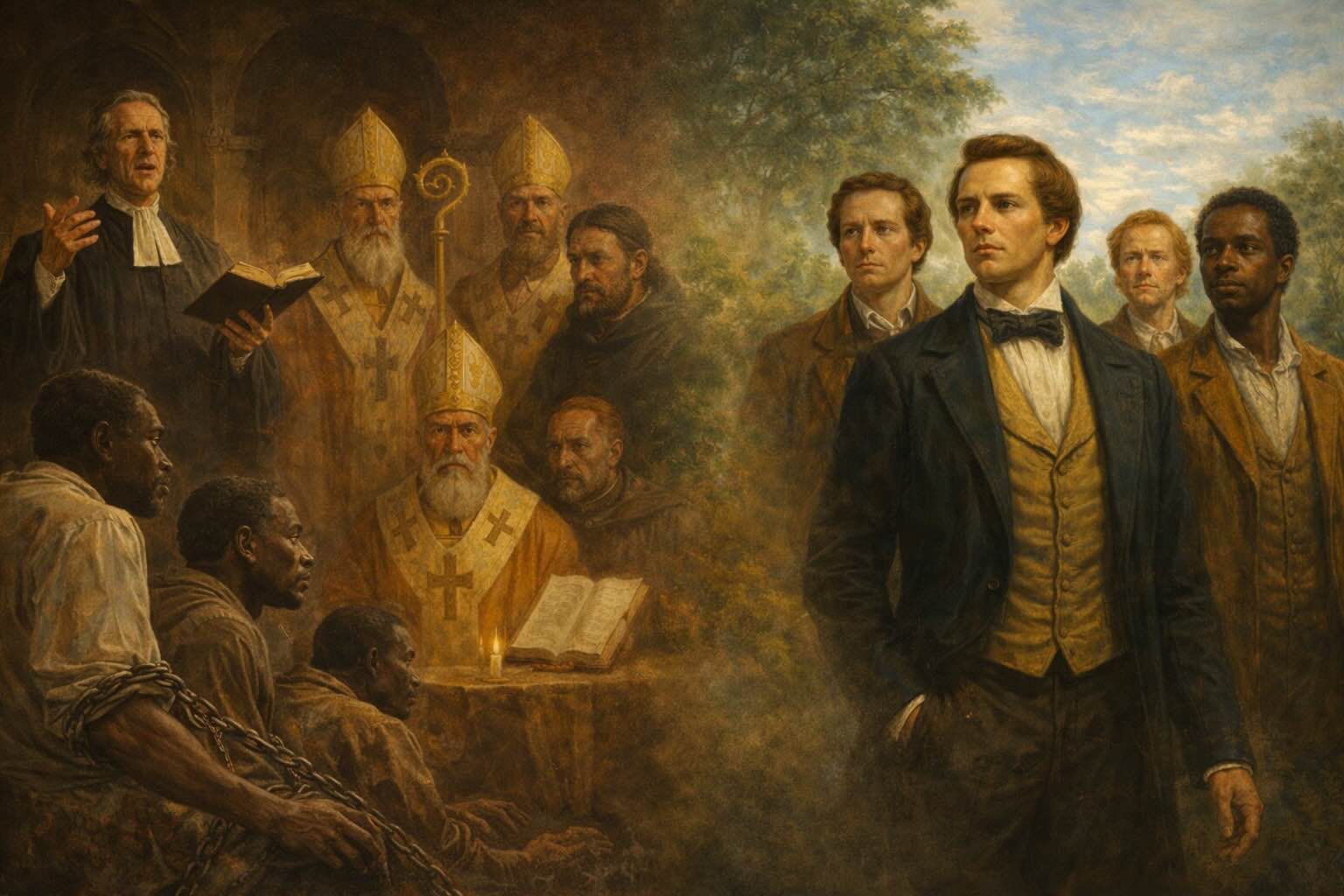
Slavery, Race, and Religion in Early America: An Interfaith Historical Analysis
How LDS History Compares to Mainstream Christianity on Slavery and Race
A historical examination of Christian teachings on slavery, Joseph Smith’s abolitionist views, and the challenges of honest interfaith dialogue.
Why This Matters
Many Evangelicals and other Christians criticize early Latter-day Saints for later racial restrictions (post–Brigham Young), but they rarely acknowledge:
What their own denominations taught about slavery
How overwhelmingly pro-slavery mainstream Christianity was
How radically different Joseph Smith’s views were from most churches of his day
Understanding this levels the playing field and fosters honest, respectful conversation.
1. What Mainstream Christianity Taught About Slavery (1700s–1800s)
Southern Baptists, Methodists, Presbyterians
These denominations, today very large Evangelical bodies, were deeply divided over slavery.
Facts:
Southern Baptists were literally founded in 1845 because they defended slavery and wanted missionaries who owned enslaved people.
Many Methodists and Presbyterians split over whether slavery was moral.
The most common arguments used:
The Bible “permits slavery.”
Abraham owned servants, therefore slavery must be acceptable.
Paul told slaves to obey masters.
Slavery was part of God’s social order.
Ending slavery would “destroy the Christian family structure” (common southern argument).
A pastor in Georgia famously preached:
“Slavery is ordained of God for the good of both races.”
Rev. Thornton Stringfellow (Baptist minister, Virginia, 1850s)
These beliefs were normal, mainstream Christian teaching in much of America.
2. The Catholic Church in Early America
The Catholic Church as a global institution wrestled with slavery for centuries.
In the 1800s:
Many American Catholic bishops owned enslaved people.
Jesuit priests in Maryland sold 272 enslaved people to financially support Georgetown University in 1838.
Some Catholic orders defended slavery as “not intrinsically evil” until later in the 19th century.
Rome eventually condemned the slave trade strongly, but practical enforcement was slow and uneven.
3. Joseph Smith & Early Latter-day Saints:
A Very Different Position (More Progressive Than People Realize)
Joseph Smith opposed slavery when it was dangerous to do so
In the 1830s–1840s:
Speaking out against slavery in the Midwest was politically lethal.
Anti-slavery activists were routinely murdered or mobbed.
Whole towns were burned for abolitionist activity.
Yet Joseph Smith:
1. Publicly opposed slavery
He published anti-slavery statements as early as 1833, when doing so was highly unpopular.
2. Proposed a national plan for abolition
During his 1844 presidential campaign, Joseph Smith proposed the federal government purchase freedom for every enslaved person in America by 1850.
This was a radical abolition plan far ahead of its time.
Some historians believe openly advocating this contributed to rising tensions that led to his assassination.
3. Baptized Black members
While most Christian churches would not baptize African Americans as equals, Joseph Smith:
welcomed Black converts
ordained at least one Black man (Elijah Abel) to the priesthood
allowed full fellowship and membership participation
This was unheard of in nearly all Christian denominations at the time.
4. Taught that all humans are literal children of God
This theological framing directly undermined pro-slavery Christian ideologies.
4. What Happened After Joseph Smith: A Historical Turning Point
It’s fair and honest to acknowledge:
Brigham Young introduced restrictions (1852) on Black priesthood ordination.
These restrictions lasted until 1978.
But it is equally honest to say:
This shift happened after Joseph Smith, not under him.
It mirrored American racial tensions after the Civil War.
Many mainstream Christian denominations maintained segregation and racial restrictions well into the 20th century, much later than 1978.
Example:
Many Evangelical churches were segregated until the 1960s.
Bob Jones University banned interracial dating until 2000.
Pentecostal denominations split over race in the early 1900s and many remain racially divided today.
5. The Key Point for Interfaith Dialogue
Every religion in early America had to grapple with slavery and race.
The Latter-day Saints were not perfect, but Joseph Smith’s teachings were actually more progressive than most churches at the time.
All Christian groups have had to grow, repent, and evolve. Including us, including you, including everyone.
6. Quick Summary
Mainstream Christian churches in early America overwhelmingly supported slavery.
Joseph Smith and early LDS teachings were anti-slavery, more inclusive, and more progressive than most churches of his day.
Later LDS racial restrictions came after Joseph Smith, during a highly racialized era.
Every Christian tradition has had to grow.
Healthy interfaith relationships require honesty about everyone’s history, not selective criticism.
Author’s Note
My name is Marlon A. Medina, and I write this as both a friend to my fellow Christians and a committed member of The Church of Jesus Christ of Latter-day Saints.
I am not a theologian or academic. I’m a Las Vegas community leader, a believer in Jesus Christ, and someone who cares deeply about strengthening relationships between faith traditions. My goal in sharing this comparison is simple:
to build understanding, honesty, and unity among Christians who are working together to make our communities better.
Every church, mine included, has had moments in its history that require reflection, humility, and growth. My intention is not to argue or criticize, but to give context so we can speak truthfully to one another, with compassion and fairness.
I believe deeply that interfaith friendships can heal old wounds, bring clarity where there has been confusion, and unite us in causes that matter: uplifting youth, defending religious freedom, protecting the vulnerable, and serving our neighbors.
Thank you for taking the time to understand where I’m coming from. My hope is that this opens doors for healthy, respectful, Christ-centered dialogue across our Christian family.
Marlon A. Medina
Las Vegas, Nevada
Interfaith Advocate & Community Partner


